Where to Stay in Lisbon? The Best Neighbourhoods Compared
Baixa & Chiado, Alfama, Bairro Alto, Príncipe Real, Estrela or Parque das Nações? Which neighbourhood suits your Lisbon trip, location, transport links, noise and price.
By lissabon.info editorial team · Travel editors · Last updated: June 2026
Contents
Lisbon is the city of seven hills, which is exactly why choosing the right neighbourhood is the most important accommodation decision you'll make. It determines how flat your routes are, how many flights of stairs you'll climb with your suitcase, how loud the nights get, and how much you'll pay per night. This guide covers the six neighbourhoods that work best as a base, with their strengths, weaknesses and concrete transport links. For specific hotel picks across every category, see the Best Hotels guide.
Baixa & Chiado, central, flat and well connected
Baixa & Chiado is the simplest choice as a base. Baixa sits on the flat pombaline grid in the valley between the hills, the three main squares, Praça do Comércio, Rossio and Praça da Figueira, are only a few minutes' walk apart, and it's roughly 10 minutes down the pedestrian street Rua Augusta to the river. If you don't want to haul a suitcase up and down steps, this is the place.
Transport links here are the best in the city. Baixa-Chiado is an interchange station for the Blue and Green metro lines, with Rossio (Green Line) and Restauradores (Blue Line) close by. From the airport, you'll reach Baixa-Chiado in about 20 to 25 minutes on the Red Line to Alameda, changing there to the Green Line. One note on the terrain - Chiado sits higher than Baixa, and the Chiado exit of the metro station ends at a steep run of escalators; the alternative for bridging the height difference is the Santa Justa Lift, about 220 metres northeast of the station.
The price is the catch. Baixa-Chiado is the most expensive central patch of the city, five-star hotels here can cost up to around €250 a night, while a mid-range three-star in Chiado averages about €153. In exchange, this is where you're most likely to save on taxis and hassle.
Alfama, picturesque, but steep and without a metro
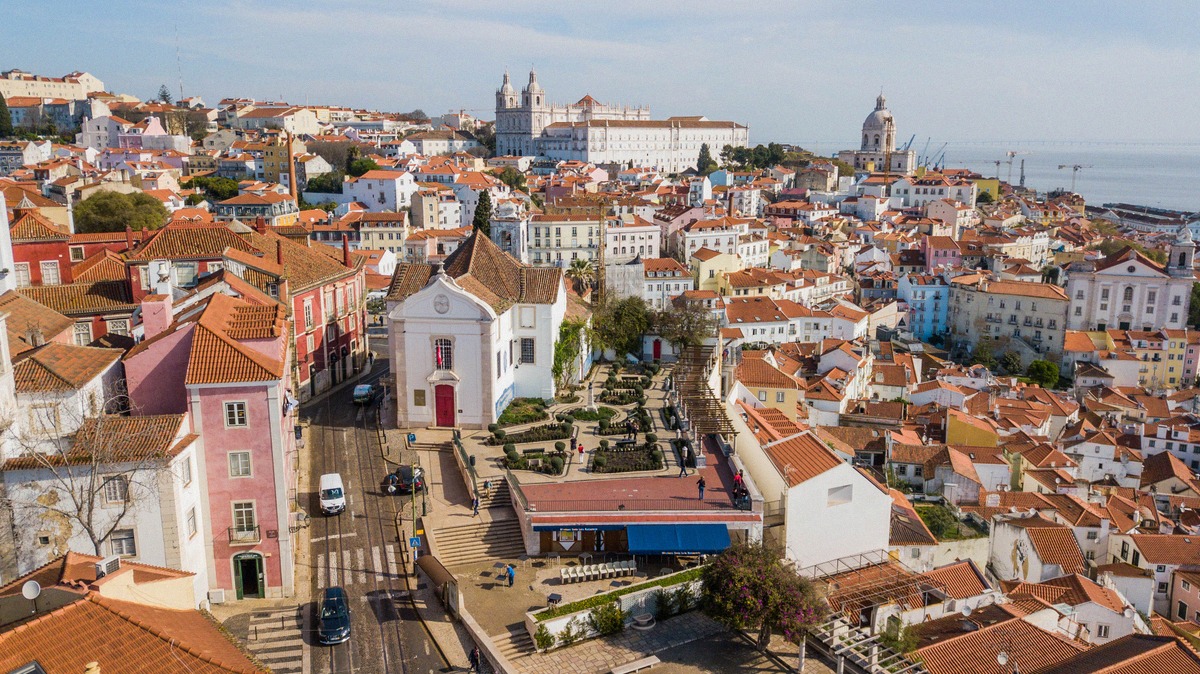
Alfama is Lisbon's oldest and most photogenic neighbourhood, spread across the steep hillside below São Jorge Castle and the Church of São Vicente. Narrow lanes, steps and azulejo tiles make up the charm, and they're exactly what makes the neighbourhood hard work with luggage. If you book here, expect steep walks and look for a hotel with a lift or a tram stop nearby.
Transport links are also a weak point. Alfama has no metro station of its own at its core, the nearest are Santa Apolónia and Terreiro do Paço (both Blue Line) on its edges. The main way to get around is the historic Tram 28, which runs through the neighbourhood; the central stop is Largo das Portas do Sol. It's scenic, but often crowded and no substitute for a fast connection.
In return, you're right in the heart of fado country. Well-known venues in the neighbourhood include Clube de Fado near Lisbon Cathedral (Sé), Mesa de Frades in a former 18th-century chapel decorated with azulejos, and the small, intimate A Baiuca with its tavern feel. Light sleepers should bear in mind that such venues can be audible late into the evening. On price, Alfama runs a little cheaper than Baixa, a four-star hotel here can cost around €45 a night less than its Baixa equivalent. More on this in the Fado guide.
Bairro Alto, the nightlife district, with a noise caveat
Bairro Alto sits on the São Roque hill and is the city's densest nightlife district. By day it's a quiet residential quarter; by evening it becomes the centre of Lisbon's nightlife, the highest concentration of bars is along Rua da Atalaia and Rua da Rosa, with Rua do Diário de Notícias and Rua da Barroca close behind. The bars are small, and much of the crowd drinks out on the street.
That's exactly the caveat. Staying here means expecting noise at weekends, on Fridays and Saturdays, most bars' indoor service winds down around 3:00, and street drinking is usually scaled back by around 2:00 under the city's noise rules. A room facing a courtyard, or earplugs, aren't a luxury here. For night owls, on the other hand, the location is ideal, since you can walk home.
The height difference from Baixa is bridged by the Elevador da Glória, a funicular running from Praça dos Restauradores up into the neighbourhood; at the top is the Miradouro de São Pedro de Alcântara, one of the city's finest viewpoints. Large hotels are scarce in Bairro Alto, the options here lean towards boutique and aparthotel stays.
Príncipe Real, elegant, central and quieter
Príncipe Real is the choice for anyone who wants to be central but quieter. This elegant neighbourhood sits on the hill above Bairro Alto and Chiado, both a few minutes' walk away, it's about 15 minutes downhill to Baixa-Chiado. It's considered one of the city's most stylish quarters, with concept stores, cafés and well-kept townhouses.
The nearest metro station is Rato on the Yellow Line, about 4 to 10 minutes on foot. The hilltop setting means some climbing, but in exchange you're away from the Bairro Alto noise while still close enough to the action. Príncipe Real suits travellers who want to explore the centre on foot but value peace and quiet in the evenings.
Estrela and Parque das Nações, quiet, green or modern
If you're after more peace or more space for a family, it's worth looking beyond the historic core.
- Estrela is quiet, green and family-friendly. Opposite the Estrela Basilica lies the Jardim da Estrela with two playgrounds. The central stop is Tram 28 (also Tram 25); the neighbourhood has no metro station of its own. A good choice for anyone who wants a quiet quarter with a park on the doorstep.
- Parque das Nações is modern Lisbon on the Tagus, about 6 km northeast of the centre. It's served by the Oriente metro station (Red Line), also home to the Lisbon Oceanarium. Oriente sits on the same Red Line as the airport, so the neighbourhood is reachable from the airport without changing lines. It's spacious, flat and quiet, but lacks old-town character, and you'll need to travel in to reach the historic centre.
Both neighbourhoods work well for families, longer stays or travellers with a car, and less well for a short sightseeing trip where every minute of travel counts.
Finding the right neighbourhood for you
A few rules of thumb help with the decision:
- Short on time, packed itinerary - Baixa & Chiado. Flat, superbly connected, everything within walking distance, but the most expensive.
- Old-town character and fado - Alfama, if steps and the lack of a metro don't put you off.
- Nightlife on your doorstep - Bairro Alto, with earplugs and ideally a courtyard-facing room.
- Central but quieter - Príncipe Real or leafy Estrela.
- Family trip or longer stay - Parque das Nações.
Two things apply across every neighbourhood. First, Lisbon is hilly, only Baixa and Parque das Nações are genuinely flat, while Alfama, Bairro Alto and Príncipe Real sit on steep slopes. If you're not steady on your feet or are travelling with a lot of luggage, factor that in, or choose a hotel with a lift and a tram or metro stop close by. Second, the season drives the price - July and August are peak season with the highest visitor numbers and prices, while December (aside from Christmas), January and February are the quietest and cheapest months. More on this in the Best Time to Visit guide. For which specific hotels are worth it in each neighbourhood, see the Best Hotels guide.