Miradouro de Santa Luzia
Tiled viewpoint terrace in Alfama
Overview
Lisbon's best viewpoints at a glance - Senhora do Monte, Santa Luzia, São Pedro de Alcântara and Graça, all four free to visit. With location, best time of day, how to get there and quieter alternatives.
Tiled viewpoint terrace in Alfama
Viewpoint garden in Bairro Alto
Viewpoint under pines in Graça
Lisbon's highest viewpoint, above Graça
No results found.
Lisbon is known as the city of seven hills, and that's exactly what makes it so rewarding to explore: almost every ridge opens onto a miradouro, a viewing terrace above rooftops, the Castelo and the broad sweep of the Tagus. These classic terraces are public squares and free to visit, many have a small kiosk, and the best of them rank among the most memorable things a visit to the city has to offer. This overview covers the four most worthwhile, with a clear sense of where it gets busy and where you'll find some quiet.
The claim that Lisbon is built on seven hills isn't a tourist-board invention but a literary tradition: the monk Frei Nicolau de Oliveira listed them in 1620 - São Jorge with its Castelo, São Vicente, Sant'Ana, Santo André, Chagas, Santa Catarina and São Roque. Geographically there are, strictly speaking, more rises than that, and the highest one in the historic centre doesn't even make the classic list: the Colina da Graça behind the Castelo, which reaches around 100 metres. Its summit is where you'll find the Miradouro da Senhora do Monte, the highest viewpoint in the old town.
In practical terms, that means the most famous viewpoints fall into two groups on either side of the valley. To the east, above and around Alfama and the Castelo, Santa Luzia, Graça and Senhora do Monte sit close together and combine well into one walk. To the west, above Bairro Alto, stands São Pedro de Alcântara, looking back towards the Castelo. If you're short on time, pick one viewpoint per side of the valley.
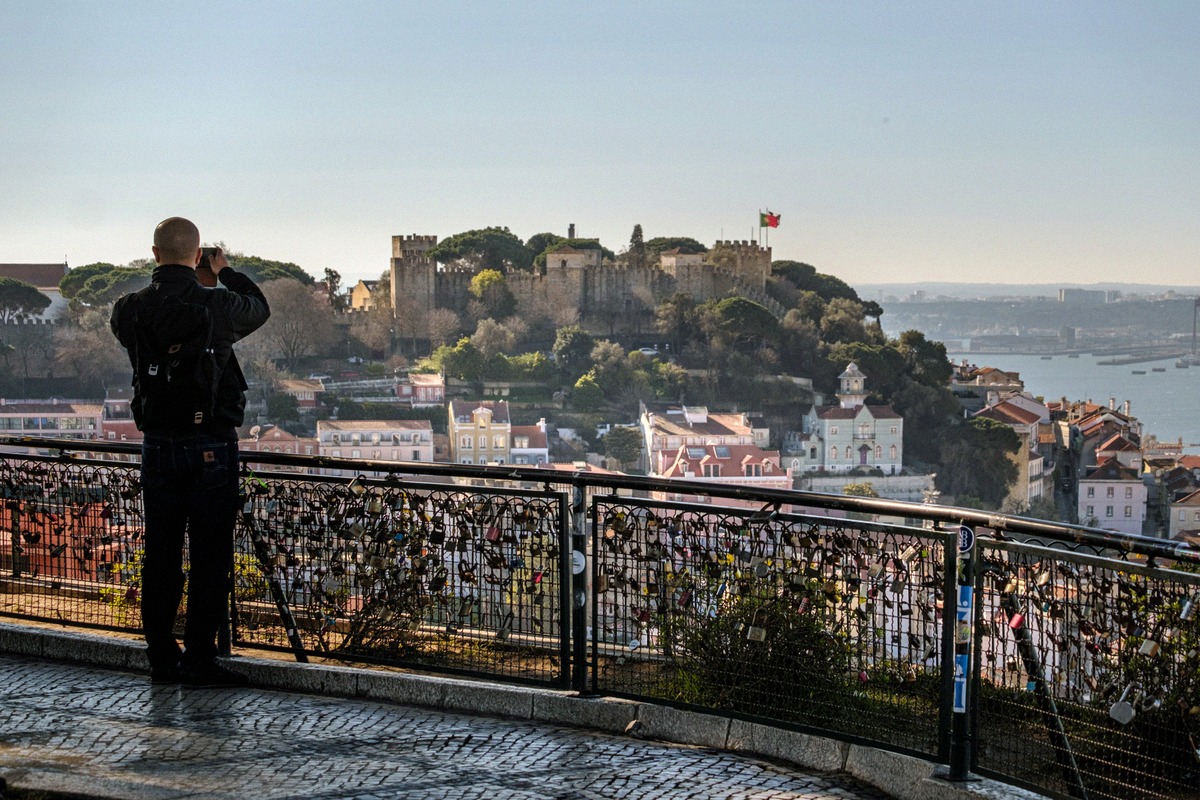
Miradouro da Senhora do Monte sits on Rua da Senhora do Monte in the Graça neighbourhood and is the highest of the four viewpoints covered here. From the simple terrace with its small chapel, Nossa Senhora do Monte, the view stretches across the Castelo de São Jorge, the Mouraria below, the rooftops of the old town and all the way to the 25 de Abril Bridge.
Because it sits a little off the main routes and well above the surrounding streets, Senhora do Monte is noticeably quieter than the terraces directly above Alfama, until sunset, when the steps fill up here too. There's little in the way of a kiosk or seating; if you want to linger, nearby Graça is the better choice. The walk up follows steep, cobbled streets. To cut the climb short, take Tram 28 to the Rua da Graça stop and walk the remaining 400 metres or so up Rua da Senhora do Monte.
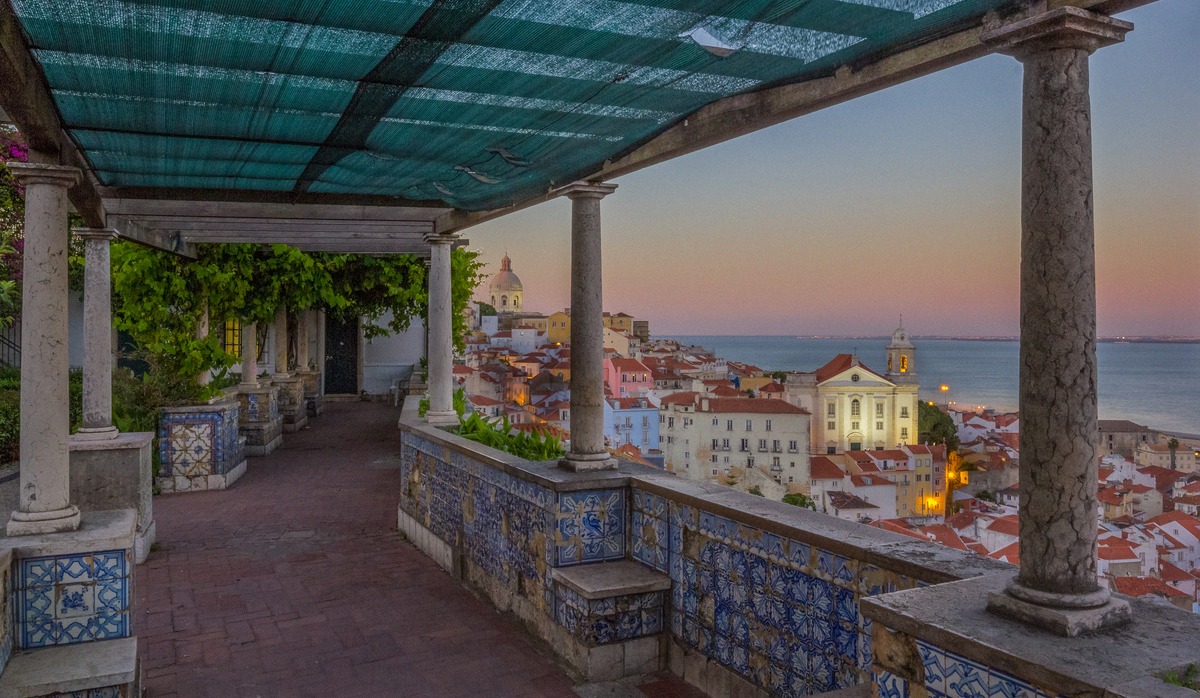
Just below the Castelo, on Largo de Santa Luzia right on the tram line, sits the Miradouro de Santa Luzia, the most photogenic of the four and our top recommendation. Next to the church of the same name, a pergola covered in bougainvillea frames a view across the tangled streets of Alfama down to the Tagus. Right next door is the equally famous Portas do Sol viewpoint.
The standout feature is a pair of large blue-and-white azulejo panels on the church's south wall. They're the work of António Quaresma, made at the storied Viúva Lamego workshop. One shows the Praça do Comércio, then known as Terreiro do Paço, as it looked before the 1755 earthquake, the other depicts the siege of the Castelo de São Jorge during the conquest of Lisbon in 1147. If you know how to read the imagery, there's a piece of the city's history on that wall. Unlike Senhora do Monte, here you can settle in at the kiosk and terrace bar. Santa Luzia and Portas do Sol are among the busiest spots in the city, though, so during the day you'll be sharing the best vantage points with a crowd.
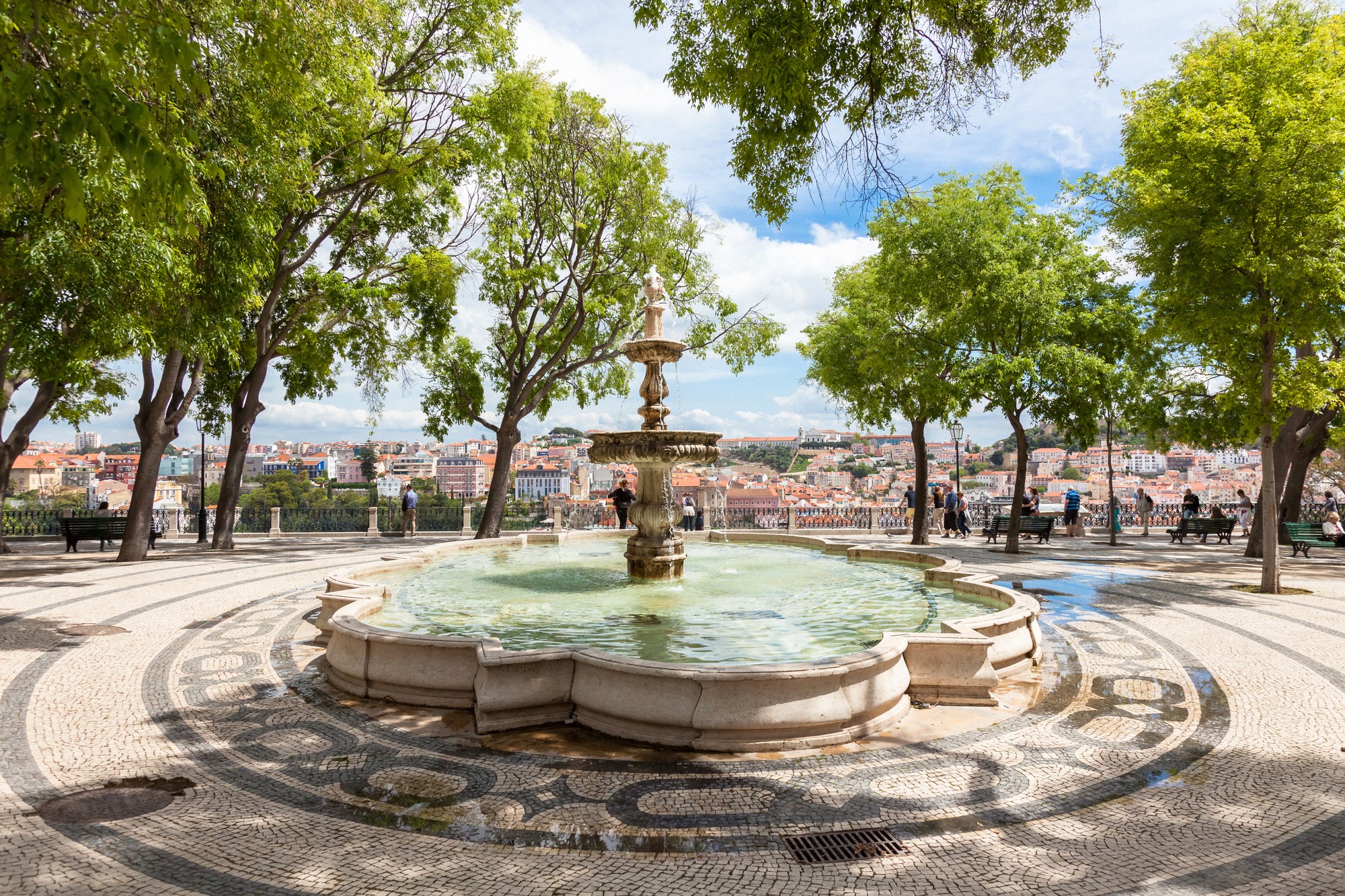
On the west side of the valley is the Miradouro de São Pedro de Alcântara, on the street of the same name at the top of Bairro Alto. Unlike the terraces above Alfama, this is a two-tiered, well-kept garden with a fountain, busts and benches, looking straight across the Baixa to the Castelo opposite, a postcard scene in the evening. An azulejo panel by Fred Kradolfer (1962) labels the landmarks in view and helps you make sense of the skyline.
The viewpoint has long been convenient thanks to its position at the top of the historic Elevador da Glória funicular. Worth knowing for planning purposes: as of June 2026 this funicular remains out of service following the serious accident in September 2025, with no reopening date set. As a replacement, Carris route 51E runs electric minibuses from Restauradores up to Bairro Alto, daily from around 7:00 to 21:30, and since late May 2026 it has been running right past the miradouro again. Alternatively, walk up from Praça Luís de Camões in Chiado. There's a kiosk right at the viewpoint for a drink with a view.
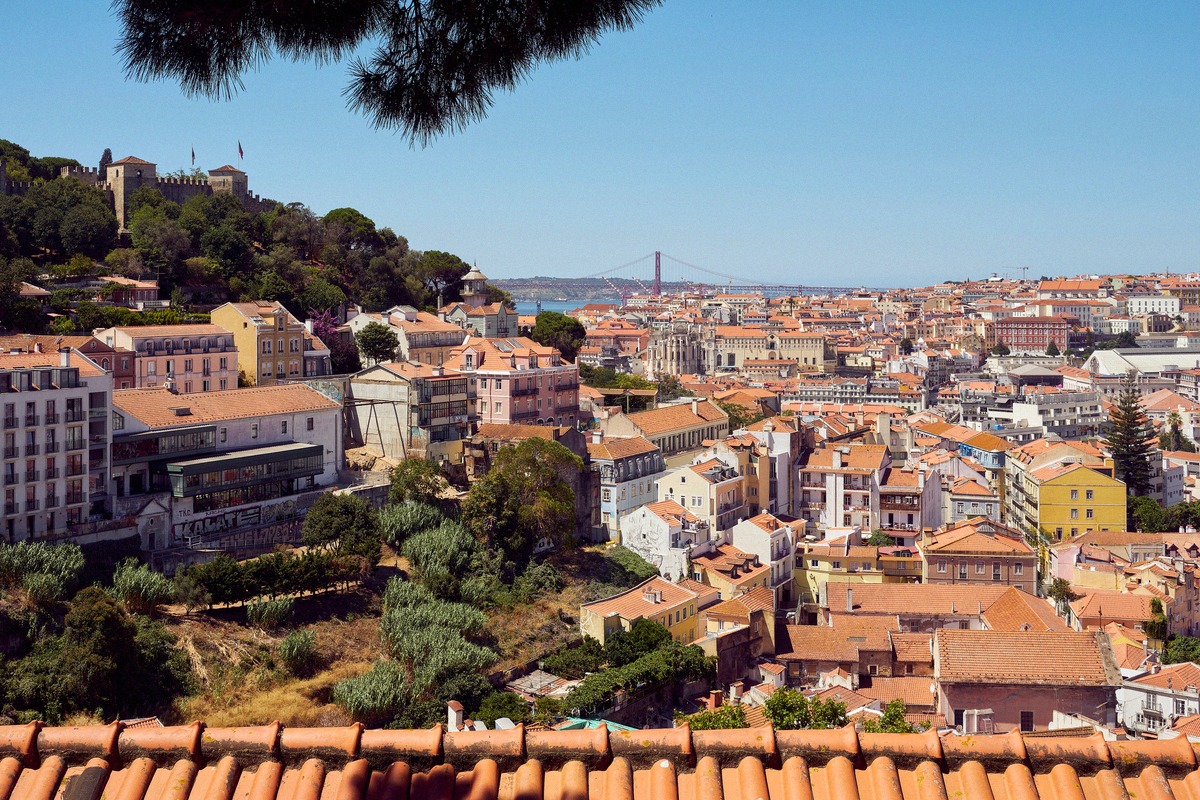
The Miradouro da Graça now officially carries the name Miradouro Sophia de Mello Breyner Andresen, after the poet. It sits on Calçada da Graça next to the church and convent of Graça and, as a public square, is open around the clock. Under shady umbrella pines, the Esplanada da Graça kiosk offers seating looking out over the Castelo and the setting sun behind it.
Graça is the old town's classic sunset gathering spot, the atmosphere in the evening is convivial without ever getting as packed as Santa Luzia. Since it's close to Senhora do Monte, the two combine well: start with the wide, quiet view up at Senhora do Monte, then head down for a drink under the pines at Graça as the sun sets.
The miradouros are at their most atmospheric during the golden hour just before sunset, when the light turns the rooftops and the Tagus gold. In June 2026 the sun sets late, around 21:00 at the start of the month, and not until around 21:06 on the summer solstice, 21 June, with a good half hour of twilight afterwards. Plan to arrive 30 to 45 minutes beforehand, earlier still at the popular Santa Luzia and Graça, if you want to secure a spot. If you'd rather avoid the crowds, come in the early morning, when you'll often have the terraces largely to yourself.
For getting there from the city centre, old-town Tram 28 is the classic option: it links Martim Moniz, Rua da Graça, Portas do Sol and Santa Luzia with the Sé and Chiado, though it's chronically overcrowded in summer. An alternative for the east side is bus 737, a Carris minibus running from Praça da Figueira via the Sé up to the Castelo (returning via Santa Luzia, journey time around 8 minutes, roughly every 10 to 15 minutes during the day), it's considered less crowded than the tram, but it doesn't serve Graça or Senhora do Monte, so Tram 28 remains the direct route there. São Pedro de Alcântara is reachable on foot from Praça Luís de Camões or on the replacement bus 51E from Restauradores. For ticket and route details, see the guide Getting around Lisbon.
There's been a change with the historic funiculars in 2026: the Bica funicular has been running again since 1 June 2026, after a general overhaul, through its steep lane between Bairro Alto and Cais do Sodré (on-board fare €4.30 for up to two rides). Only the Ascensor da Glória and the Lavra funicular remain closed.
If you're coming straight from the airport, take the red metro line from the terminal, change to the green line towards Martim Moniz at Alameda, and you'll be right at the foot of the climbs; more detail in the guide From the airport to the city centre.
If the four classics feel too crowded, these quieter viewpoints offer a comparable view:
For which viewpoints pair well with the major sights, see the overview Attractions in Lisbon; for when the light and weather are at their best, see the guide Best time to visit Lisbon.